Atom.
Tiny habits, big results.
— A habit app designed from behavioural research —
About Atom.
An app to practice Atomic Habits — right on your home screen, every day.
Built on systems, not willpower. Two minutes a day shapes who you are 365 days later.
An animated demo of the Atom app: tapping a habit's option logs today, fills today's grass cell green, and raises the score and streak; the month calendar then fills with green for every consistent day.
Why we built it
The three tiers did not come from a theory. They came from what actually kept working.
Every habit app I tried logged one of two things: did it, or didn't. On a bad day, doing the light version counted the same as doing nothing. Which means you can be keeping a habit and have the record say you broke it.
I could not find an app that recorded how far you got in three tiers and could still tell you, on a bad day, that you at least made it this far. So I built one.
That is exactly the shape of how I ended up going to the gym. The first goal was only to walk outside. I walk to the shops anyway, so that one is already met. Once I'm outside, the next goal is just to go to the gym — go in, turn around, come home, still counts.
But once I'm at the gym, I'll do one set on the bench. And once I've done one, I look up and an hour has gone. Lowering the step to get started was the whole intervention; the rest happened on its own.
Atom's three tiers are that structure turned into a tool. Every habit has to define its lightest action, and the reason is simple: so there is no such thing as a day you did nothing.
Rules Incorporated
This app incorporates the following rules introduced in Atomic Habits by James Clear.
Make it Obvious
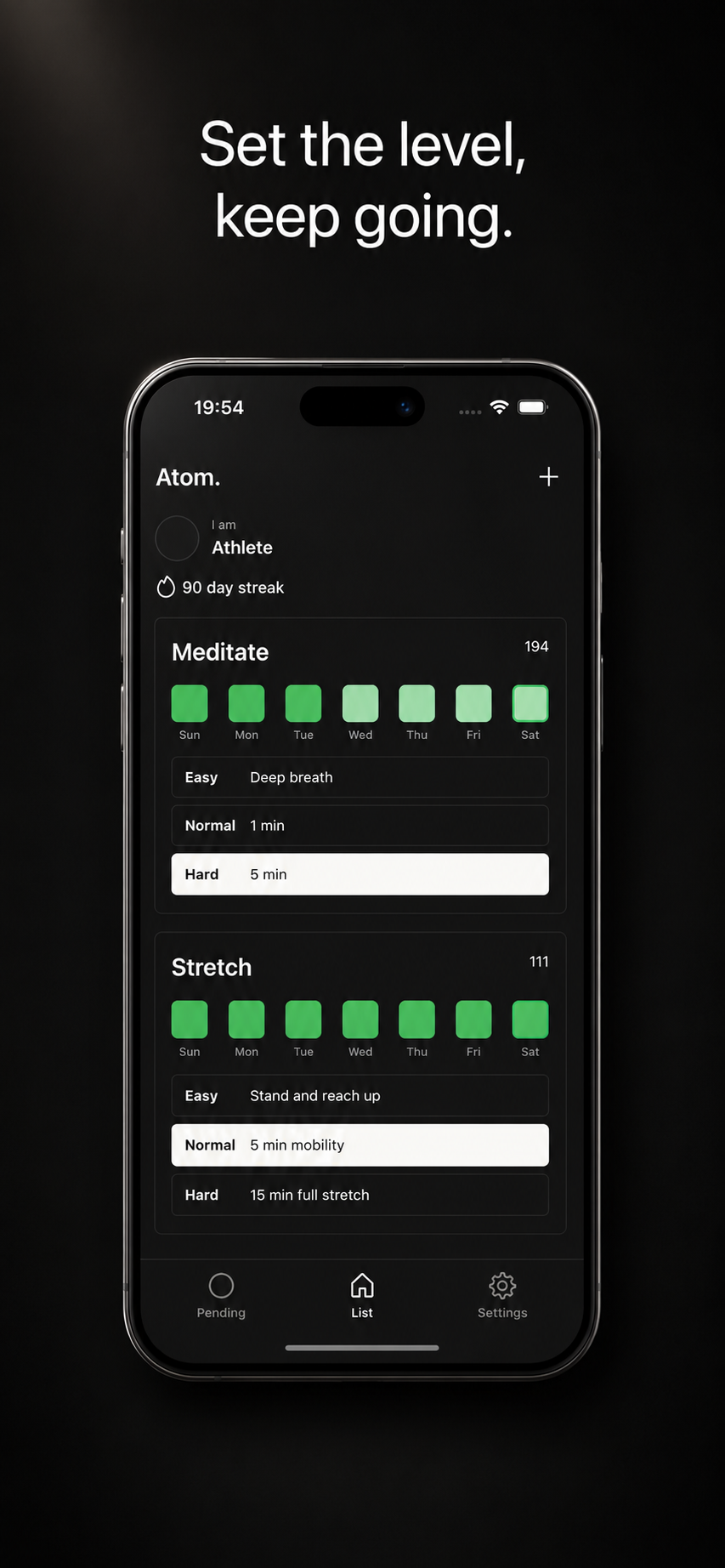
Your tickets live on the home screen and widget — always in sight, always one glance away.
Make it Attractive
Instant score gains and a growing grass calendar give you a reward worth coming back for.
Make it Easy
Four taps to log. One tap from the widget. Every habit comes with a two-minute fallback so the bar to keep going stays within reach.
Identity-based Habits
Tickets are framed as "I am ___" identity declarations. You see who you want to become, every day.
Never Miss Twice
Even the lightest action fills your calendar. Skip once, return tomorrow, the streak survives.
Implementation Intention
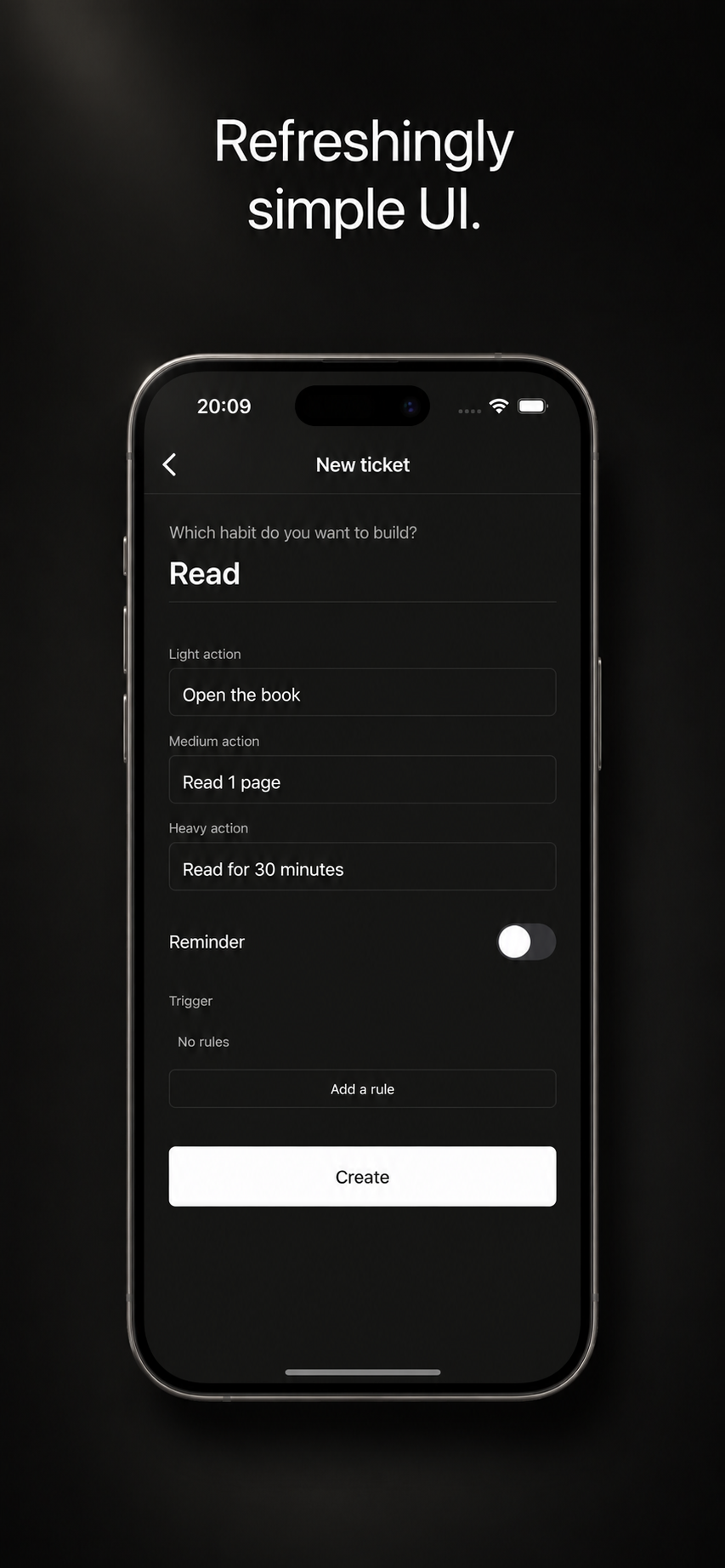
Set when and where with reminders. Fixed triggers make the habit impossible to forget.
* Not the official Atomic Habits app.
What it does
Three tiers per habit
Decide a light, a medium and a heavy version of each habit up front, then tap whichever you managed today. They are worth 1, 3 and 7 points.
A grass calendar of the days you kept
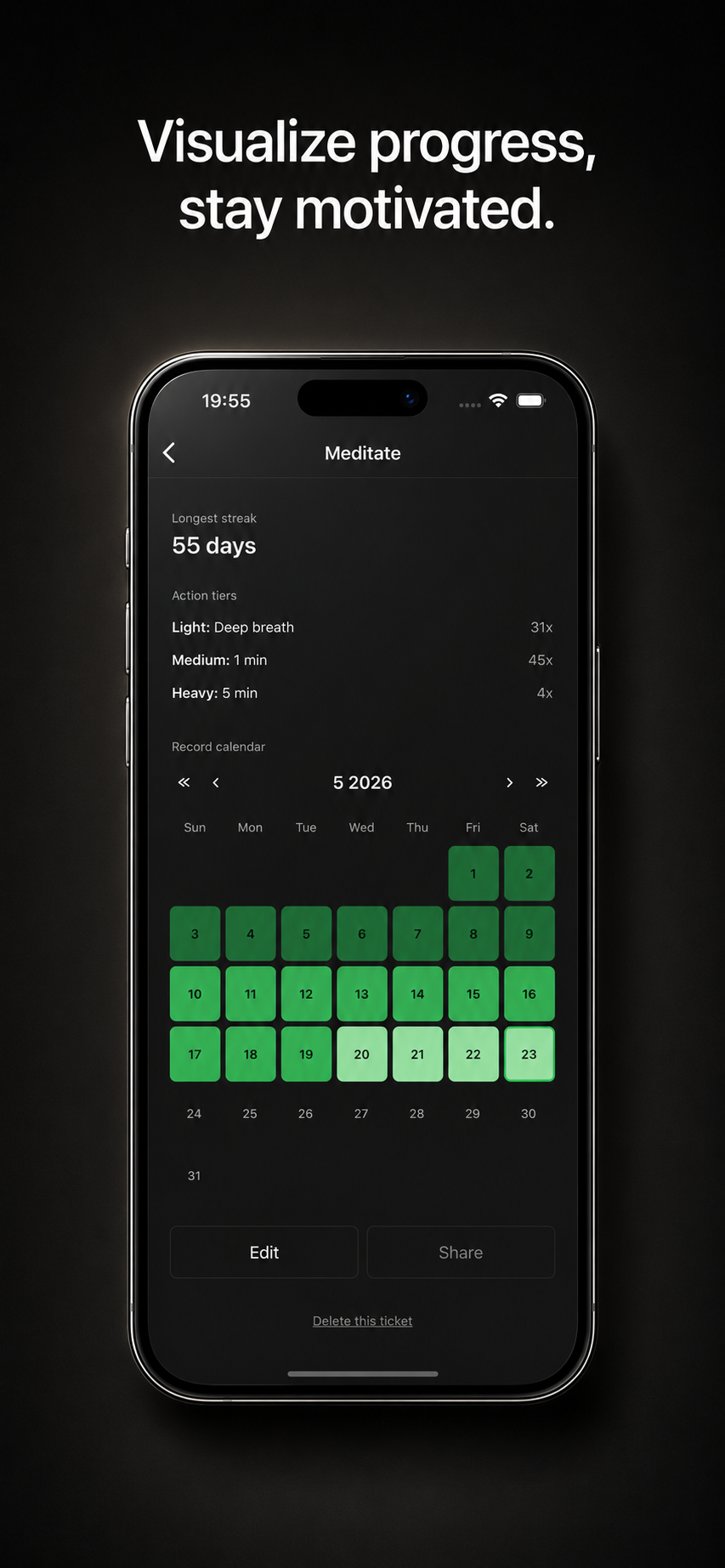
Every logged day turns green, darker for the heavier action, so a month reads at a glance.
Home screen widgets
There are widgets on both iOS and Android. You can log from there without opening the app.
Streaks
It shows how many days you have kept going. Even the lightest action keeps the streak alive.
When-and-where reminders
Each habit can carry a reminder. They all run on the device and they are free.
Your log never leaves the device
Habits and entries live in a database on your phone. Nothing is sent to a server.
10 languages
English, Japanese, Korean, Chinese (Simplified and Traditional), German, Spanish, French, Italian and Brazilian Portuguese.
What we deliberately left out
What it will not do — and what it does include — stated up front.
Removing the ads
The app shows ads. That is how it stays free, and right now there is no way to pay them away.
Syncing or backing up across devices
The trade for having no account is that your log lives on one device. There is no way to carry it to another one yet.
Leaderboards and comparing with other people
There is nothing to compete in. The only comparison is with the version of you from yesterday.
Promising a habit in N days
How long automaticity takes ranges from 18 to 254 days depending on the person (Lally et al. 2010). We do not promise a number.
Questions
Is it free?
Yes. Every feature is free. In exchange, the app shows ads.
Do I need an account?
No. There is no login and no email to enter — install it and it works.
Does it work offline?
Yes. Habits and entries are stored in a database on your device, and logging needs no connection. The only thing that uses the network is the ads.
Will it send me notifications?
Only if you set them. There is a daily reminder and a per-habit reminder; both run on the device and both are free. We do not send notifications that hold a streak hostage.
How should I pick the three tiers?
Set the lightest one at a level you could manage on a bad day. For the gym, “walk outside” is a legitimate light action. The lightest action still paints the calendar green.
Is my data sent anywhere?
Your habit and log data stays in a SQLite database on your device and is not sent to mibuki. Because the app shows ads, Google AdMob may collect advertising identifiers, device information, approximate location, and ad impression or click data. See the privacy policy for details.
What this is built on
Evidence comes in different strengths. We keep the layers apart instead of mixing them.
1. Our own measurements
None yet. Atom keeps your log on your device and we do not aggregate usage data. When we have something we can measure and publish, it goes here.
2. Peer-reviewed research
Tested experimentally and through peer review. Each of these maps onto a specific design decision in Atom.
Implementation intentions
Deciding in advance when and where you will act raises the rate at which people reach their goals. A meta-analysis of 94 independent tests and over 8,000 participants reports a medium-to-large effect (d = .65).
In Atom — reminders let you set the when and the where, not just the what.
How long a habit takes to become automatic
The median was 66 days — but the spread is enormous: 18 to 254 days. That is from 96 volunteers, among those the model fitted. The familiar “21 days to a habit” has no finding like this behind it.
In Atom — we promise no number of days. The design assumes it takes a long time and that you will miss days, so returning the next day costs you nothing (Never Miss Twice).
The goal-gradient effect
Effort toward a goal increases as the goal gets closer. Seeing the distance shrink is itself what makes the next step lighter.
In Atom — the grass calendar keeps both what you have done and what is left in view.
3. Frameworks we designed from
Books and frameworks written by practitioners. They shaped the design, but they are not peer-reviewed research, so we do not call them scientific backing.
Atomic Habits (James Clear)
The four laws (Make it Obvious / Attractive / Easy / Satisfying), the Two-Minute Rule, Never Miss Twice, and identity-based habits.
In Atom — carried straight into the screen layout and the way a ticket is written. Atom is not an official Atomic Habits app.
Clear, J. (2018). Atomic Habits. New York: Avery.
Tiny Habits / B=MAP (BJ Fogg)
A framework in which behaviour happens when motivation, ability and a prompt arrive at the same moment — with the emphasis on making the behaviour itself small.
In Atom — every habit must define a light action you can finish in two minutes.
Fogg, B. J. (2019). Tiny Habits: The Small Changes That Change Everything. Boston: Houghton Mifflin Harcourt.
Every work listed here had its author, year and venue checked against Crossref. The DOIs go to the originals.
What goes in and what stays out is decided by three principles. Those criteria, and the list of things we refuse to do, are published.
Read mibuki's approach →What is established about habit formation? →Inside the App
Last updated: July 2026