The LangDict brand mark: a spark for AI and a word card for language learning, set on crossing lines — AI multiplied by language learning.
LangDict
A dictionary of only the words you chose.
— A vocabulary app where AI builds the materials —
Type a word. Get a card.
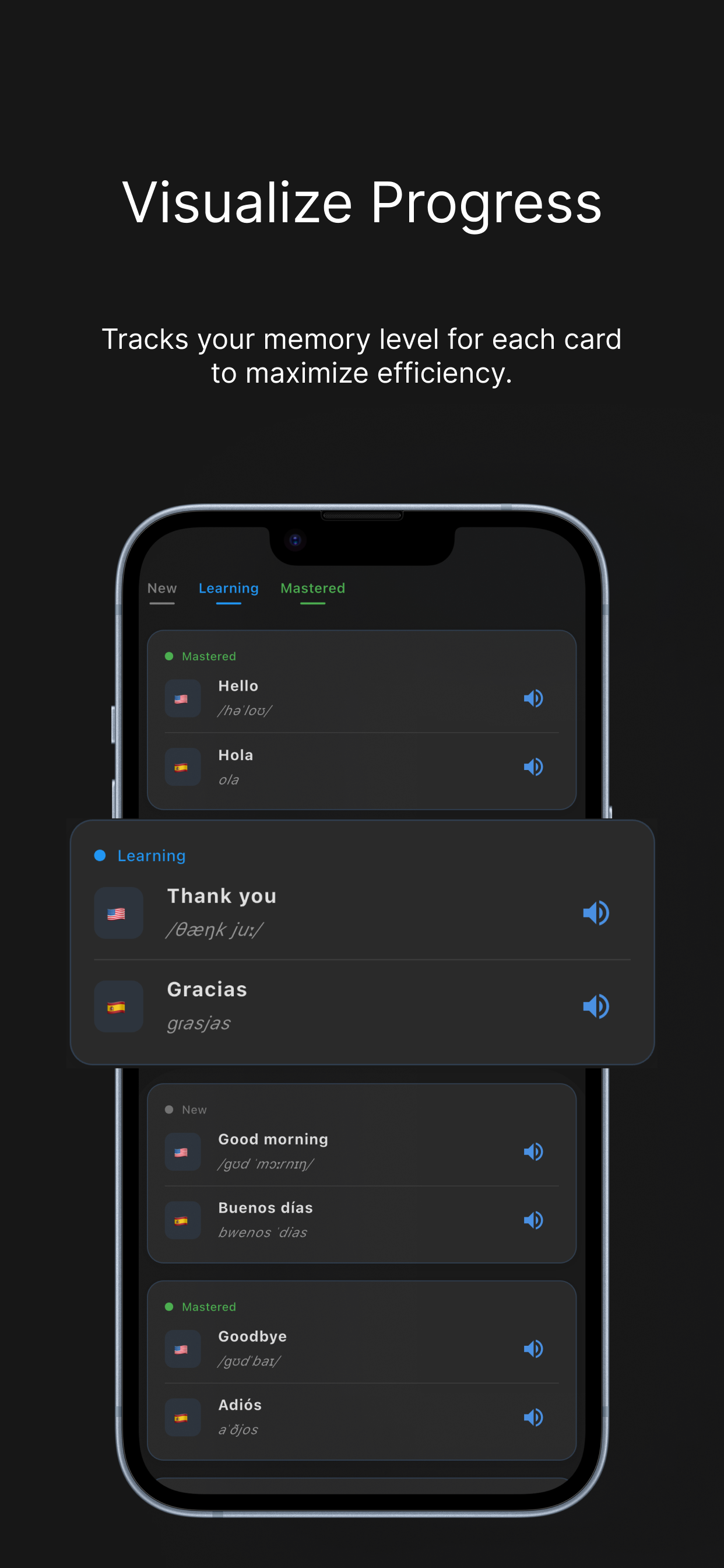
Just add the words you want to remember. AI writes the translations and example sentences, and every card gets phonetic transcriptions automatically. Review timing is decided by Lexa, our own memory model.
Enter a word you want to remember, and it becomes a card — translation options, an example sentence, and phonetic transcription already in place.
Is this where you get stuck?
You know which words you want — making the cards is what stops you
Look up the meaning, think of an example, hunt down the pronunciation. You burn out before you even start studying.
The app keeps feeding you words that aren't yours
You want the phrase from today's conversation, but the course insists on teaching you something else.
No phonetic transcriptions
Memorize a word without knowing how it sounds, and the wrong pronunciation is what sticks.
Lexa
Review timing, decided by our own model
A spaced-repetition scheduler predicts when you should review. The industry standard, FSRS, personalizes by optimizing parameters for each user. Lexa takes a different route: it reads the review history of your other cards as context, so a single shared model adapts its predictions to you — with no per-user tuning.
The method, data, and scores are published in our research report.
Read the research report →What it does
Fast translation, straight to cards
It suggests translation candidates in both languages. Pick one and it becomes a card as-is.
Phonetic transcriptions on every card
Every card gets them, automatically. No looking things up yourself.
AI deck generation
Type a topic and it generates a whole deck. Drop the cards you don’t need in the preview.
Text-to-speech
Play the audio for any card. Autoplay is supported too.
17 languages, any pair
Flip the learning direction with a single tap.
Records and stats
A study calendar, per-language-pair breakdowns, and your streak.
Translate from photos (paid)
Turn text captured in a photo into cards on the spot.
Inside the App
Fast translation, straight to cards
It suggests translation candidates in both languages. Pick one and it becomes a card as-is.
An animated demo of LangDict: the word "Love" is typed into the search field, its pronunciation /lʌv/ appears, and three Spanish translations arrive — Amor (amor, Neutral, general), Cariño (kariɲo, Casual, term of endearment) and Querer (kerer, Neutral, to want/love). One is tapped and saved to the deck as a card.
Why we built Lexa ourselves
FSRS is an excellent model, but its per-user optimization needs a certain amount of data. The newer you are to studying, the less you benefit.
How easily you memorize, and how mature your learning is, differ from person to person. We wanted to handle that without retraining for each user.
So we used large public collections of review logs to build a Transformer-based model. It reads the history of your other cards, personalizing without any tuning.
Why we built it
In 2024, on a working holiday abroad, I kept wishing I could turn the words and phrases I had used that day straight into a flashcard deck.
Anki demanded too much setup before I could study. Duolingo wouldn’t let me study the words I wanted. And almost none of the apps had phonetic transcriptions.
I wanted something that could build a deck straight from a conversation log, transcriptions included. That is why I built this.
Now it can generate review cards automatically from English lessons, or from records of conversations in other languages.
What we deliberately left out
This app is built for people who choose their own words. If that isn’t you, here is what may not fit — stated upfront.
A course that picks words for you
There is no fixed sequence of words to march through. You choose what to learn. This is an app for remembering the words you actually use.
Pronunciation scoring or correction
Not included. We see this as an app for remembering words, not for practicing pronunciation.
User-to-user deck sharing
We built it once, then removed it. AI can generate the decks you need — and the more shared decks pile up, the harder it becomes to know which one to use.
Offline translation and AI generation
These need a connection. Studying and your records work offline.
What goes in and what stays out is decided by three principles. Those criteria, and the list of things we refuse to do, are published.
Read mibuki's approach →What is spaced repetition? →What is free and what is not
The same boundary the FAQ describes, as a table.
| Feature | Free | Paid plan |
|---|---|---|
| Creating, studying and reviewing cards | Unlimited | Unlimited |
| Automatic phonetics on every card | Yes | Yes |
| Any pair of 17 languages | Yes | Yes |
| Review scheduling by Lexa | Yes | Yes |
| Studying and logging offline | Yes | Yes |
| AI deck generation | Capped | Uncapped |
| Choice of generation model | Fixed | Higher-accuracy models selectable |
| Cards from images and PDFs | — | Yes |
Prices are shown on the App Store and Google Play listings and on the purchase screen in the app. They vary by region, so they are not reproduced here.
FAQ
Do I need an account?
No. Install it and start — there is no login and no email address to enter.
How accurate is Lexa?
On three public benchmarks (Anki / Duolingo / maimemo), it outperformed FSRS-7's default settings — the industry standard. The method, data, and scores are published in our research report. Note that this comparison measures how accurately memory retention is predicted; it is not a measurement of learning outcomes themselves.
I want to learn pronunciation — is there a feature for that?
Phonetic transcriptions are added to every card automatically, and text-to-speech is supported. There is no pronunciation scoring or correction, though.
Which languages are supported?
17 languages, and you can study any combination of them.
How much can I do for free?
All the basic features are free. The paid plan removes the limit on AI deck generation and lets you choose a more accurate model. Creating cards from images and PDFs is also a paid-plan feature.
Does it work offline?
Studying and your records work offline. Translation and AI generation need a connection.
Do I have to pick every word myself?
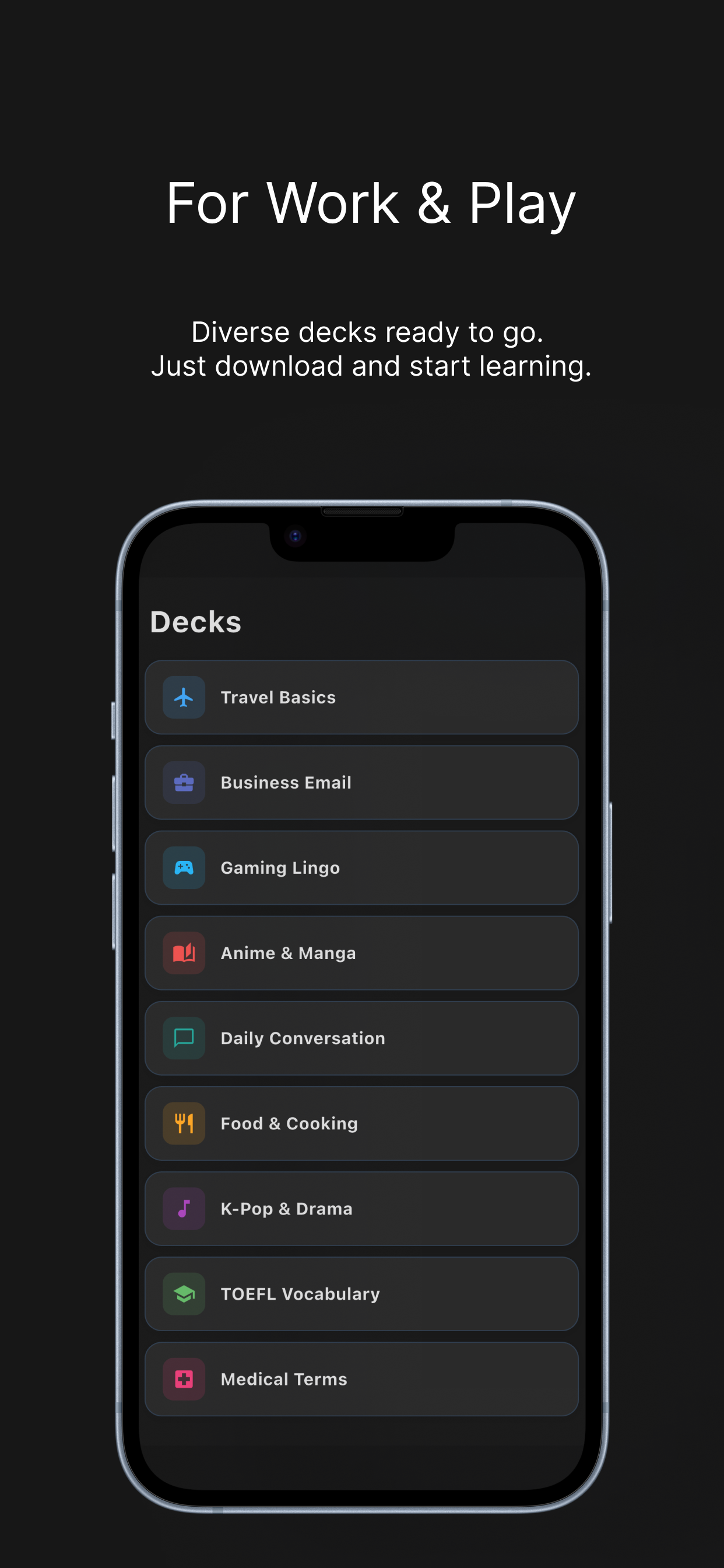
Mostly, yes — the app is built around choosing what you learn. That said, there are official decks ready to use, and AI deck generation from a single topic, so you never have to start from zero.
Download
Available on the App Store and Google Play. Free on iOS / Android.
iOS / Android app
Last updated: July 2026